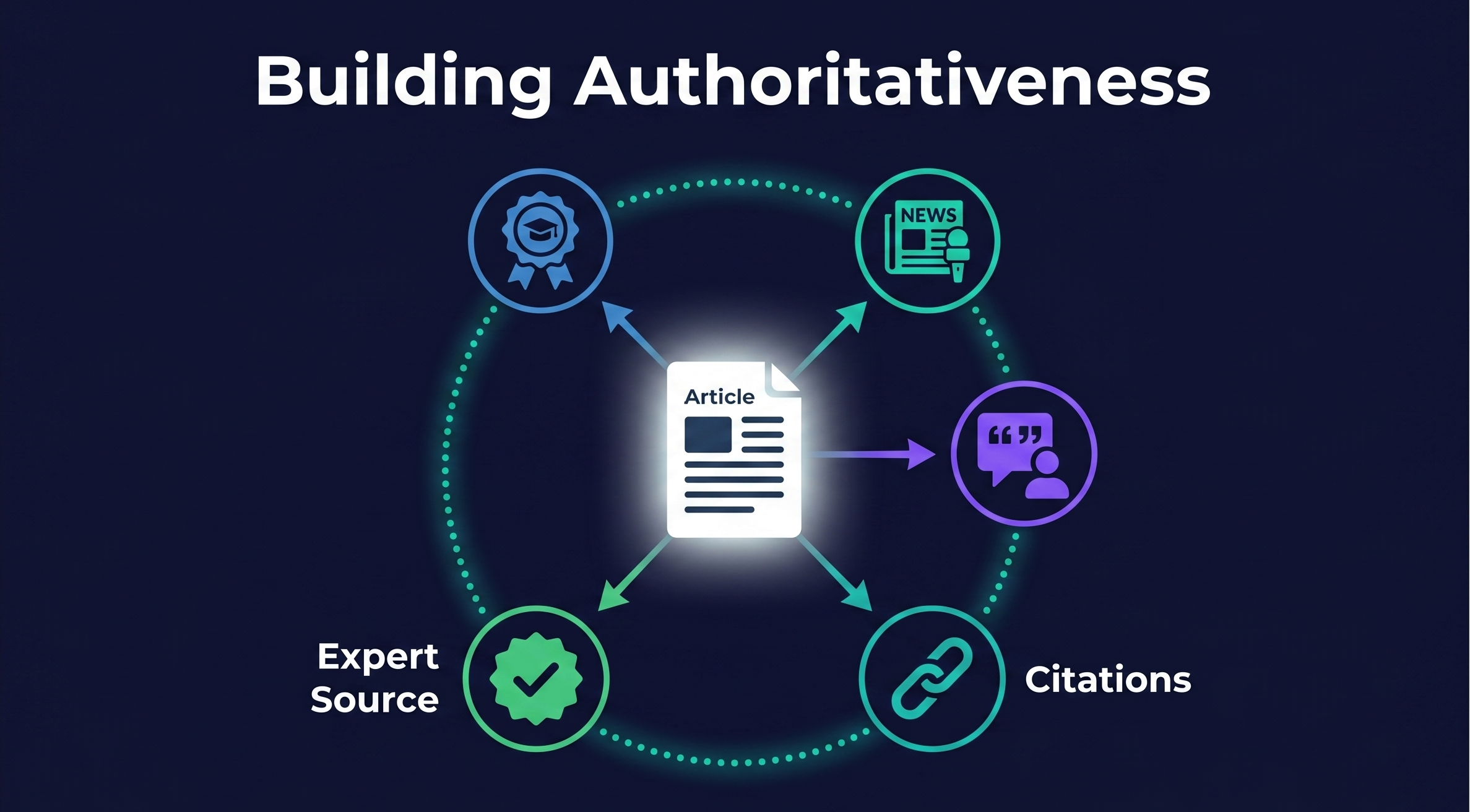
Authoritativeness is the most widely misunderstood dimension of E-E-A-T. The common assumption is that it is essentially a backlink metric: that authority flows from external sites linking to yours, and that on-page content has little to do with it. That assumption is half right and half wrong, and the half that is wrong is costing many publishers rankings they could otherwise hold.
Google's Search Quality Rater Guidelines distinguish between two types of authority signals: the authority of the site (built largely through external recognition, links, and reputation) and the authority of the specific page (built through how that page handles evidence, sources, and expert voices). Both matter. But the page-level signals are the ones most publishers neglect: and the ones most directly within your control.
This guide focuses on what you can do inside your content to build authoritativeness, regardless of your domain's backlink profile.
What Authoritativeness Actually Means to a Quality Rater
When a Google quality rater evaluates a page for authoritativeness, they are asking a specific question: Is this page recognised as a credible, knowledgeable source on this specific topic? Not on all topics: on this one. A legal blog that consistently cites case law and quotes practising solicitors is authoritative on employment law even if it has modest domain authority. A high-DA news site that publishes a shallow explainer on the same topic, with no named legal sources, is less authoritative on that specific question despite its overall reputation.
This distinction matters because it shifts the question from "how strong is our domain?" to "does this specific piece of content demonstrate command of the subject?" The latter is something you can act on immediately.
Citations: The Foundation of On-Page Authority
Every factual claim in your content sits on a spectrum from fully supported to completely unverified. The position of your claims on that spectrum is what quality raters assess when they evaluate authoritativeness.
Primary sources over secondary sources
A citation only adds authority if it is traceable. Linking to another blog post that references a study is weaker than linking to the study itself. Linking to a news article about a government report is weaker than linking to the report. Quality raters are specifically trained to follow citation chains: and a chain that terminates in a paywalled academic paper or an official government document is significantly more credible than one that terminates in a Medium post.
Where primary sources are behind paywalls, cite them accurately (author, publication, year, DOI if available) even without a live link. The specificity of the reference itself is an authority signal: it demonstrates that the author has actually read the source, not just seen it mentioned elsewhere.
Name the source, not just the claim
"Research shows" and "studies suggest" are authority-neutral phrases. They gesture at evidence without providing it. Replace every anonymous source reference with the specific institution, publication, or individual behind the claim:
- Weak: Research suggests that sleep deprivation affects cognitive performance.
- Strong: A 2023 study published in Nature Sleep found that reducing sleep from eight hours to six hours for two weeks produced cognitive deficits equivalent to two full nights of total sleep deprivation. (Walker et al., Nature Sleep, 2023)
The second version is authoritative not because the claim is more dramatic, but because a reader can verify it. That verifiability is the core of authority.
Currency of sources matters
Citing a 2009 study as the basis for a claim in a fast-moving field is an authority risk. Quality raters are trained to check whether sources are current relative to the topic: technology, medicine, finance, and law all evolve quickly enough that outdated citations can signal a lack of genuine engagement with the field.
If the most recent authoritative source you can find on a claim is more than five years old, acknowledge it: "The most comprehensive study on this remains [X], published in [year], though more recent data on [specific aspect] has not yet been published." That honesty is itself an authority signal: it tells the reader you know the landscape of the evidence, not just the headline result.
Expert Quotes: Adding External Voice to Your Content
A direct quote from a credentialed expert is one of the most efficient authority signals available in content. It brings a named, verifiable person with established expertise into your content and makes them accountable for the claim being made: which means the authority of their credentials transfers, in part, to your page.
What makes an expert quote effective
The authority value of an expert quote depends almost entirely on how the expert is introduced. "According to an expert we spoke to" carries no authority. The same quote introduced as "According to Dr. Rachel Ahmed, consultant cardiologist at St. Thomas' Hospital and lead author of the 2024 British Heart Foundation guidelines on hypertension management" carries significant authority: because the credentials are specific, verifiable, and relevant to the claim.
Three elements make an expert attribution effective:
- Full name: no initials, no "an expert", no "a source in the industry"
- Specific, relevant credentials: the qualification or role that makes them authoritative on this specific claim, not generic seniority
- Verifiable identity: a link to their professional profile, institutional page, or published work where possible
Original quotes versus attributed statements
The highest-authority expert content is sourced directly: an interview, a written response to specific questions, or a quote from a verified primary source such as a published paper or official testimony. Repurposing a quote from another article is lower-authority and risks being out of context.
For most content teams, getting original expert quotes at scale requires building relationships: contributing experts who review articles, subject-matter consultants, or an editorial advisory board. This is worth the investment for sites in competitive or YMYL verticals. For lower-stakes content, accurately attributed quotes from published interviews, documented speeches, or peer-reviewed papers are sufficient.
Outbound Links: Why Linking Out Builds Authority
Many publishers avoid linking to external sources out of concern about sending users away from their site. This is a false economy. Linking to authoritative external sources is itself an authority signal: it demonstrates that the content is part of a broader conversation, not an isolated claim made in a vacuum.
Google's quality raters are trained to look at the information ecosystem a page participates in. A page that cites the NHS, the Office for National Statistics, or a peer-reviewed journal is signalling that it is operating in the same information environment as those authoritative sources: not replacing them, but building on them.
Link to institutions, not just articles
When you link to support a claim, preference the institutional source over a journalist's article about that institution's findings. Linking to a government data table directly is stronger than linking to a newspaper's coverage of the same data. Both provide the reader with verification, but the institutional link carries more authority weight because the institution is the primary author of the claim.
Fewer, stronger links over many weak ones
An article that links to three primary sources: a peer-reviewed study, an official government statistic, and a named expert's published work: is more authoritative than one with fifteen links to other blog posts on the same topic. The quality of outbound links reflects the quality of your sourcing process. Link abundance without link quality signals superficial research.
Site-Level Authoritativeness: What You Cannot Fully Control
On-page signals are within your control. Site-level authoritativeness: the recognition your domain has built over time in your field: takes longer to develop and cannot be manufactured quickly. The signals quality raters consider at the site level include:
- External citations: Other reputable sites in your field referencing your content without being asked to: indicating that your work is considered a primary source worth citing
- Named contributors with independent reputations: Authors whose expertise is recognised beyond your site: through their own publications, professional profiles, or institutional affiliations
- Consistency of topic focus: A site that publishes authoritatively within a defined subject area over time builds topical authority that a generalist site cannot match, even with more total content
- Press and industry mentions: Appearances in trade publications, academic references, or reputable news coverage that corroborate the site's claimed expertise
The honest implication is that site-level authoritativeness is a lagging indicator: it reflects the quality of what you have published over time, not what you published last week. The practical priority is therefore to get page-level authority signals right consistently, and allow site-level recognition to accumulate as a consequence.
A Practical Authoritativeness Checklist for Every Article
Before publishing, verify the following for each piece of content:
- Every factual claim that is not common knowledge has a named, specific source
- At least one citation links directly to a primary source: not a secondary article about that source
- Any expert quoted is introduced with their full name, specific credentials, and a link to their professional profile or published work
- Outbound links go to institutional or primary sources where possible, not competing content
- The author's credentials relevant to this specific topic are visible on the page
- Any claim that rests on older evidence acknowledges its age and, where applicable, notes the absence of more recent data
You can also run your finished content through Credify's E-E-A-T Checker: the Authoritativeness dimension score specifically reflects citation quality, source credibility, and the presence of expert voices in the content. A score below 55 on that dimension typically indicates one of the gaps above.
"High E-E-A-T news sources have a good reputation for producing accurate and trustworthy content... They have won awards or are highly cited or talked about by other high-quality sources.": Google Search Quality Rater Guidelines, 2023
The path to that recognition is built one well-sourced, carefully attributed article at a time. There is no shortcut, but there is a clear process: and it starts with treating every claim in your content as something a reader should be able to verify independently.
Related reading: Trustworthiness Signals: What Google Wants to See on Every Page · The E-E-A-T Pre-Publish Checklist: 26 Signals to Check