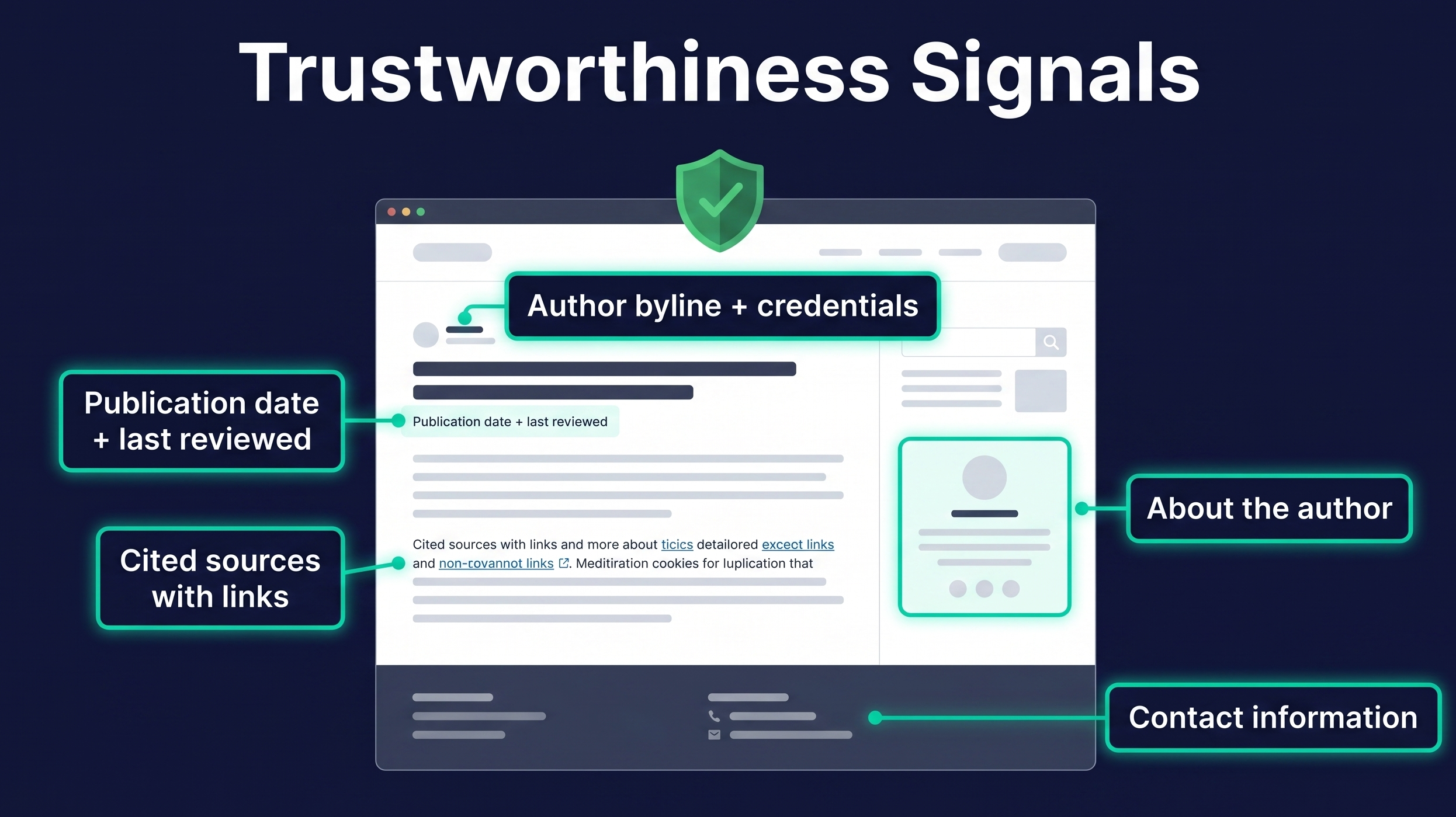
Of the four E-E-A-T dimensions, Trustworthiness carries the most weight. Google's Search Quality Rater Guidelines state it directly: "The most important member of the E-E-A-T family is Trust." A page can demonstrate experience, expertise, and authority: but if it fails the trust test, those signals count for little.
What makes Trustworthiness distinct from the other three dimensions is that it is partly about what your content says and partly about how your site presents itself. A technically accurate, well-sourced article on a site with no contact information, no author identity, and a broken privacy policy will still score poorly on trust: because the infrastructure that makes a site credible is missing.
This guide covers both layers: the on-page signals quality raters look for in individual pieces of content, and the site-level signals that establish a foundation of trust across your entire domain.
Why Trustworthiness Is the Foundation, Not Just Another Dimension
Google's reasoning here is straightforward: misinformation presented confidently by an apparent expert is more dangerous than obvious low-quality content. A site that looks authoritative but makes false or misleading claims is precisely what Google's quality systems are designed to demote: because users are more likely to act on it.
The practical consequence is that failing on Trustworthiness can negate strong signals in the other three dimensions. In audits of content that lost rankings after core updates, a recurring pattern emerges: pages with high Expertise scores (accurate, technically detailed content) but low Trustworthiness scores (no author, outdated dates, no citations) consistently underperform compared to moderately expert content on highly trustworthy sites.
Build trust signals first. Then layer expertise on top.
On-Page Trust Signals
These are the signals quality raters check on the specific page they are evaluating: not just the site as a whole.
Named author with verifiable credentials
The single highest-impact trust signal on any content page is a named author whose credentials can be verified. Anonymous content: or content attributed to "Staff Writer" or "Editorial Team": carries almost no trust value because there is no accountable person behind the claims.
The author name should link to either an on-site bio page or a verifiable external profile (LinkedIn is the most commonly recognised). The bio should include the author's relevant background, not just their job title. "John Smith, MD, Cardiologist at Leeds General Infirmary with 12 years of clinical experience" is meaningfully different from "John Smith, health writer."
For sites where multiple people contribute, each article should have an individual byline: not a shared team attribution. Shared attribution distributes accountability to no one.
Clear publication and review date
Quality raters are specifically trained to check whether content is current. An article about mortgage rates, drug dosages, or employment law that was published in 2021 and never updated is a trust risk: not because the original writing was dishonest, but because time may have made it inaccurate.
Every piece of content should display:
- The original publication date
- A "last reviewed" or "last updated" date where the content has been substantially revised
Hiding or removing publication dates: a common tactic to avoid the appearance of old content: is counterproductive. Quality raters flag missing dates as a trust negative. A visible old date with a recent review note is more trustworthy than no date at all.
Cited sources that link to primary evidence
Claims that cannot be verified by the reader undermine trust, even when they are accurate. The standard quality raters apply is whether a reasonable user could follow the content's reasoning back to its source.
This means linking to primary sources: the actual study, the official guideline, the original data: not to other articles that reference the study. A financial article that cites "a recent Deloitte report" should link directly to that report, not to a press release about it.
Quantity of citations matters less than quality and accessibility. Three links to primary sources (government data, peer-reviewed research, official documentation) carry more trust weight than fifteen links to other blog posts.
Balanced claims with acknowledged uncertainty
Trustworthy content is honest about what is not known, where evidence is contested, and where individual circumstances might change the conclusions. Content that presents every claim with equal certainty: regardless of the actual strength of evidence: reads as promotional, not authoritative.
Specific patterns that trigger low trust ratings from quality raters include:
- Absolute claims in areas of genuine scientific debate ("X definitely causes Y" where the evidence shows correlation, not causation)
- Omitting significant counterevidence or opposing viewpoints in topics where they exist
- Commercial content presented as neutral advice without disclosure of any financial relationship
- Forecasts or predictions presented as fact rather than probability
Adding a single sentence that acknowledges the limits of a claim: "current evidence suggests, though longer-term studies are limited": often does more for trust than several paragraphs of confident prose.
Transparent corrections policy
How a publisher handles errors is itself a trust signal. Sites that silently edit incorrect content: removing the original claim with no acknowledgement: are behaving less transparently than sites that add a correction note with a date. Quality raters are trained to view visible corrections as a positive signal, not a negative one: they indicate a site that cares about accuracy more than appearances.
A simple correction note at the bottom of an updated article: "Correction, 14 April 2026: an earlier version of this article stated X. The correct figure is Y.": takes thirty seconds to add and signals genuine editorial standards.
Site-Level Trust Signals
These signals are checked once at the site level but affect the trust evaluation of every individual page on your domain.
Accessible contact information
A site with no contact information is harder to hold accountable: which makes it less trustworthy by definition. Quality raters look for a reachable email address or contact form, a physical address where relevant (essential for local businesses and YMYL sites), and evidence that someone is actually responsible for the site's content.
Contact information does not need to be on every page: a clearly labelled Contact or About page that is one click from anywhere on the site is sufficient.
Privacy policy and legal pages
The absence of a privacy policy is a direct trust signal: it suggests either that the site does not know it should have one, or that it has something to hide about how it handles user data. For any site that processes user-submitted content, collects emails, or uses analytics, a privacy policy is both a legal requirement in most jurisdictions and an E-E-A-T signal.
The privacy policy does not need to be complex. What matters is that it exists, is findable, and honestly describes what data is collected and how it is used.
Consistent site identity
A site where the About page, the author bios, and the contact information all point to the same identifiable person or organisation is more trustworthy than a site where these signals are absent or inconsistent. Quality raters check whether a site's claimed identity is coherent: a health site claiming to be run by medical professionals should have those professionals named and verifiable.
This includes consistency across the site's social profiles, external mentions, and any press coverage. A site that cannot be found anywhere outside its own domain has no corroboration for the identity it claims.
The Trust Audit: Five Questions for Every Page
Before publishing any piece of content, run through these five questions. Each "no" answer is a trust gap.
- Is there a named, credentialed author whose identity can be verified from this page?
- Is the publication date visible, and has the content been reviewed recently enough to still be accurate?
- Do all factual claims link to primary sources, not just other secondary articles?
- Does the content acknowledge uncertainty or limitations honestly, without overstating the confidence of the evidence?
- Is it immediately clear who runs this site, how to contact them, and what their credentials are?
These five questions map directly to the Trustworthiness dimension in Credify's E-E-A-T Checker. If your content consistently fails one of them, that is your trust bottleneck: and fixing it will have a more predictable impact on your scores than any amount of additional keyword optimisation.
"The most important member of the E-E-A-T family is Trust. The other members of the E-E-A-T family contribute to trust in a page or website, but Trust is the most important.": Google Search Quality Rater Guidelines, 2023
What Trustworthiness Is Not
A common misconception is that trust signals are primarily technical: SSL certificates, site speed, structured data. These are hygiene factors: their absence is a negative signal, but their presence does not make a site trustworthy. A fast, secure site with schema markup that publishes anonymous, uncited content is still a low-trust site.
Trust, in Google's framework, is fundamentally about accountability and honesty: whether real people stand behind the content, whether claims can be verified, and whether the site behaves consistently with what it claims to be. Those are editorial and organisational properties, not technical ones.
Related reading: The E-E-A-T Pre-Publish Checklist: 26 Signals to Check · What Is E-E-A-T? Google's Content Quality Framework Explained